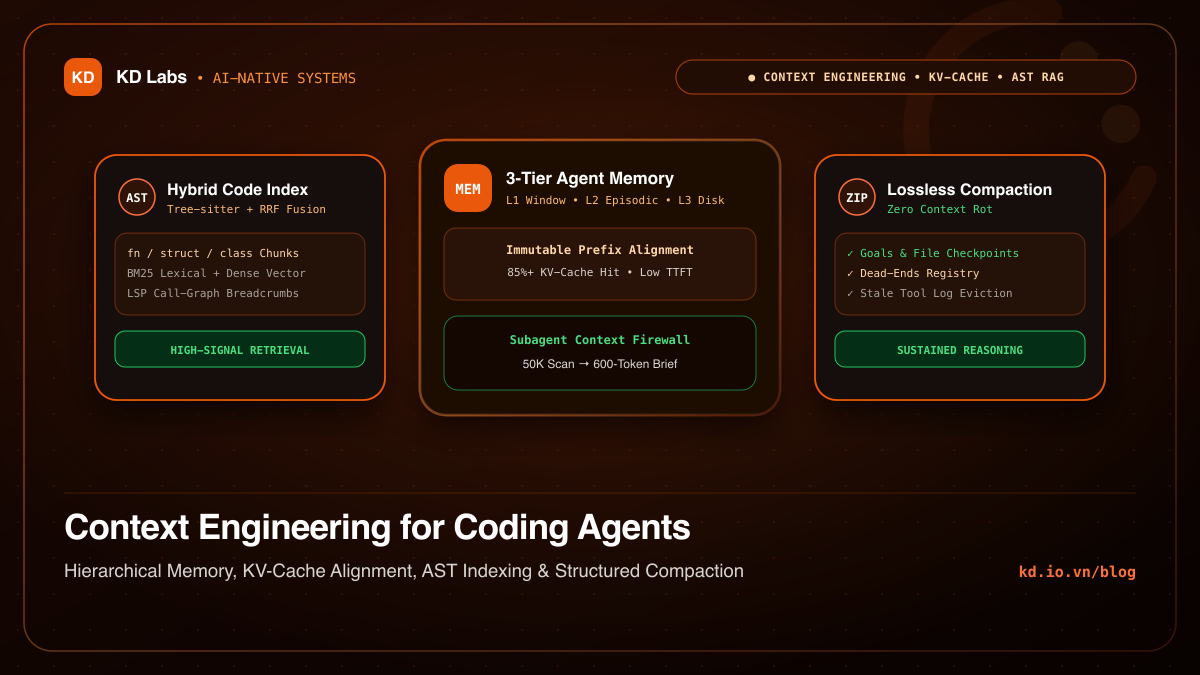
If 2023 was defined by Prompt Engineering — crafting clever one-shot instructions — the era of AI-Native software systems has decisively shifted the engineering bottleneck to Context Engineering: the systems discipline of curating, indexing, caching, and compacting everything inside an agent’s active working memory.
A modern coding agent executes dozens of iterative tool loops: traversing files, running test suites, inspecting compiler diagnostics, and applying multi-file patches. Dumping raw terminal logs and entire source trees indiscriminately into a prompt causes reasoning quality to degrade sharply — even on frontier models advertising 200K to 1M+ token windows.
1. The Long-Context Fallacy & “Context Rot”
A common misconception is that massive context windows make retrieval and memory management obsolete. Production telemetry across real-world software repositories reveals three hard constraints:
- Attention Dilution (“Context Rot” & Lost-in-the-Middle): Transformer attention mechanisms weigh the system prefix and the most recent tokens heavily, while recall and multi-hop reasoning degrade noticeably when tens of thousands of noisy intermediate tokens (such as verbose
npmlogs or lockfiles) accumulate in the middle. - Compound Multi-Turn Token Economics: An autonomous task spanning 30 tool-invocation turns re-sends the conversation trajectory on every step. Letting unpruned tool outputs bloat the prompt to 150K tokens by turn 15 turns a routine bug fix into millions of billed tokens and sluggish Time-To-First-Token (TTFT).
- Trajectory Poisoning: When an agent explores a flawed hypothesis in turn 4 and leaves 400 lines of failed code inside its active context, self-attention continues conditioning on that broken pattern twenty turns later.
Context Engineering treats the LLM context window like CPU L1/L2 cache: maximize signal density per token, preserve cache locality, and aggressively evict stale intermediate state.
2. Three-Tier Hierarchical Agent Memory
Much like a computer’s L1 Cache → RAM → NVMe hierarchy, resilient AI-Native coding architectures partition state across three distinct tiers:
┌───────────────────────────────────────────────────────────────────────────┐
│ TIER 1: WORKING CONTEXT (Active Token Window — Equivalent to L1/RAM)      │
│  • Immutable Prefix (System Prompt + Tool Schemas) ──> KV-Cache Aligned   │
│  • Repository Rules (AGENTS.md) & Active Execution Plan                   │
│  • Focal AST Slices & Unpruned Tool Outputs from Last 2–3 Turns           │
└─────────────────────────────────────┬─────────────────────────────────────┘
                                      ▲ Dynamic Paging / Structured Compaction
┌─────────────────────────────────────┴─────────────────────────────────────┐
│ TIER 2: EPISODIC & SUBAGENT MEMORY (Session State — Equivalent to L2/L3)  │
│  • Structured Checkpoint Summaries of Completed Milestones                │
│  • Context-Isolated Subagents (Consume 50K tokens, return 600-token brief)│
└─────────────────────────────────────┬─────────────────────────────────────┘
                                      ▲ Hybrid Retrieval + LSP Call Graph
┌─────────────────────────────────────┴─────────────────────────────────────┐
│ TIER 3: PERSISTENT CODEBASE GRAPH (Durable Knowledge — NVMe/Disk)         │
│  • Tree-sitter AST Symbol Index + BM25 Lexical + Dense Embeddings         │
│  • Git History, Architectural Decision Records & Test Suites              │
└───────────────────────────────────────────────────────────────────────────┘
Designing for Prefix KV-Cache Hit Rates
Modern inference engines rely on Prefix KV-Caching, slashing input token costs by 75%–90% and dramatically cutting latency — provided the leading token sequence remains byte-for-byte identical across turns.
Injecting a live wall-clock timestamp or fluctuating IDE cursor metadata near the top of the System Prompt invalidates the entire downstream KV-Cache on every single turn! High-throughput context pipelines enforce strict ordering:
- Immutable Prefix: System Instructions → Canonical Tool Definitions → Project
AGENTS.md. - Append-Only Trajectory: Conversation & Tool Turns → Ephemeral IDE State appended at the very tail.
3. Tree-sitter AST Indexing & Subagent Context Isolation
Naive text RAG splits source files into arbitrary 500-token windows, slicing function signatures away from their bodies and severing type definitions from implementations.
AI-Native developer tools combine syntax-aware indexing with agentic navigation:
- AST-Bounded Semantic Units: Using Tree-sitter, files are parsed into complete syntactic nodes (
function,class,interface,implblocks) enriched with structural breadcrumbs (file path, module imports, and enclosing type signatures). - Hybrid Lexical + Semantic Retrieval: Dense vector embeddings excel at conceptual queries (“Where do we validate webhook signatures?”), while BM25 / Ripgrep dominates exact identifier lookups (
ERR_ACP_TRANSPORT_TIMEOUT). Merging both rankings via Reciprocal Rank Fusion (RRF) delivers superior precision. - Subagent Context Firewalling: Instead of polluting the primary orchestrator’s window by reading 25 candidate files during exploratory search, the parent agent delegates discovery to a read-only Research Subagent. The subagent scans 40,000 tokens in its own ephemeral context and returns a crisp 600-token architectural summary with exact line references (
router.ts#L42-L88).
4. Lossless-Intent Context Compaction
When an extended coding session reaches 75%–80% of its effective context budget, naive prose summarization (“Summarize our conversation so far”) routinely drops critical file paths, exact compiler error codes, and subtle architectural invariants.
Production systems replace free-form summarization with Structured State Compaction combined with aggressive pruning of superseded tool outputs:
export interface CompactedSessionState {
  // Original objective and non-negotiable user constraints
  userGoalAndConstraints: string[];
  // Exact file paths touched, diff summaries, and verification status
  modifiedFiles: Array<{ path: string; summaryOfChanges: string; verified: boolean }>;
  // Approaches ALREADY TRIED THAT FAILED (prevents repeating loops!)
  deadEndsToAvoid: string[];
  // Ordered queue of remaining implementation & verification tasks
  pendingNextSteps: string[];
}
Explicitly preserving deadEndsToAvoid prevents the classic post-compaction failure mode where a freshly compacted agent immediately re-attempts an approach that failed thirty minutes earlier.
5. Practical Context Engineering in KD Code
When building KD Code at KD Labs, we designed first-class UX primitives to give engineers direct visibility and control over agent context:
- High-Signal
@ContextPinning: Pin exact files, directories, active editor selections, VS Code Problems diagnostics (Cmd+Alt+P), or the latest failed terminal output (Cmd+Alt+L) directly into the prompt instead of forcing blind repository scans. - Live Context Telemetry &
ccusageAnalytics: Track real-time context window saturation, automatic compaction checkpoints, and KV-cache efficiency directly inside the ACP sidebar. - Declarative Repository Memory (
AGENTS.md): Encode build commands, architectural boundaries, and domain conventions in a concise rootAGENTS.mdso every coding agent starts with zero-shot repository fluency.
In AI-Native software engineering, model intelligence is only half the equation. Context Engineering is the discipline that turns raw token capacity into sustained, reliable engineering execution.