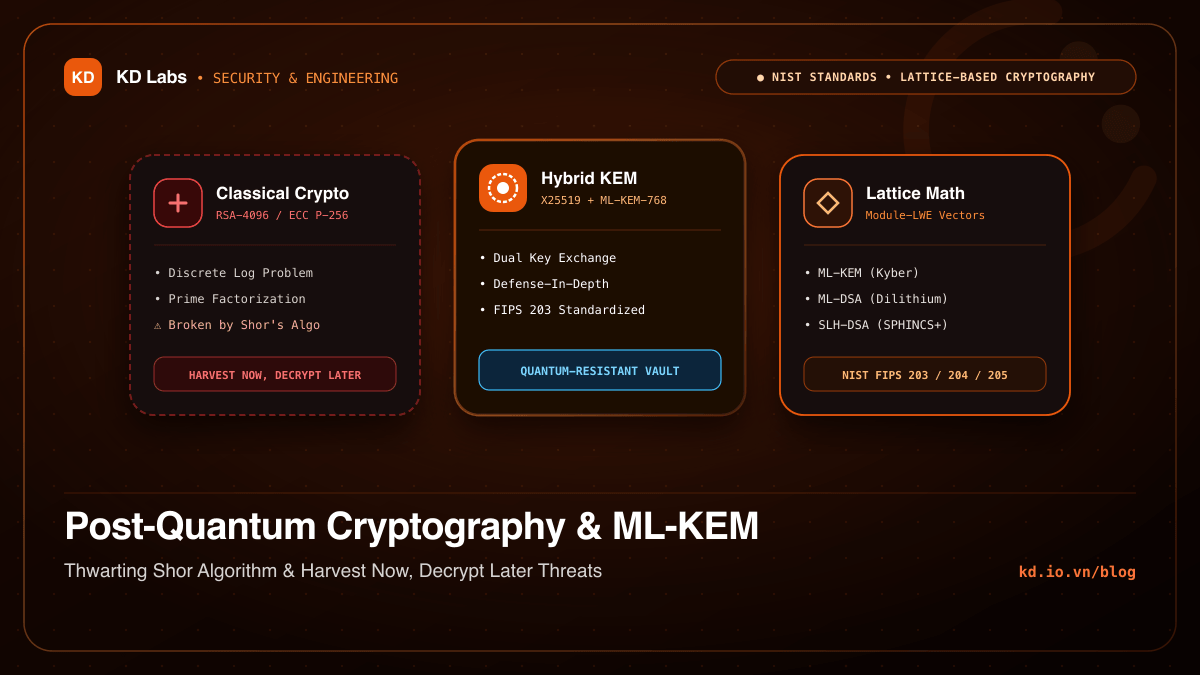
Almost every secure communication protocol across the modern Internet — from the TLS/HTTPS connection encrypting this page, SSH remote administration sessions, digital signatures, to cryptocurrency wallets — relies on a shared mathematical bedrock: Asymmetric Public-Key Cryptography, predominantly RSA and Elliptic Curve Cryptography (ECC).
The security of RSA rests upon the computational intractability of prime factorization (Integer Factorization). ECC schemes (such as ECDSA and Ed25519) rely on the discrete logarithm problem over elliptic curve groups (ECDLP). On today’s most powerful classical supercomputers, resolving these problems with standard key dimensions (e.g., RSA-4096 or ECC P-256) would require millions of years of continuous computation.
However, the advent of Fault-Tolerant Quantum Computers (FTQCs) capable of executing Shor’s Algorithm fundamentally shatters these foundational assumptions.
1. The Looming Threat of “Q-Day” and the “Harvest Now, Decrypt Later” Paradigm
A pervasive misconception in software engineering is: “We only need to worry about post-quantum algorithms when a working quantum computer is physically rolled out into commercial data centers.” In defensive cybersecurity, this perspective is dangerously obsolete.
1.1. The SNDL (Store Now, Decrypt Later) Campaign
Nation-state adversaries and advanced persistent threat (APT) groups are already conducting massive Store Now, Decrypt Later (SNDL) operations:
- Passive Ingestion: Adversaries record and siphon petabytes of encrypted public TLS handshakes, corporate intellectual property, medical records, diplomatic communications, and financial ledgers traversing undersea fiber cables.
- Cold Storage Accumulation: This encrypted payload is archived in massive, low-cost data repositories in ciphertext form.
- Mass Decryption on Q-Day: The moment a fault-tolerant quantum computer scales past the threshold of several thousand logical qubits running Shor’s algorithm, past ephemeral key exchanges (Diffie-Hellman / RSA) will be cracked within minutes, retroactively decrypting decades of accumulated secrets.
PRESENT DAY (2026)                                FUTURE (Q-DAY)
┌────────────────────────┐                        ┌────────────────────────┐
│ Encrypted TLS Streams  │ ──► Harvested and ───► │ Fault-Tolerant Quantum │
│ (RSA-4096 / ECDH P-256)│       Cold-Stored      │ Computer (Shor's Algo) │
└────────────────────────┘                        └───────────┬────────────┘
                                                              │
                                                              ▼
                                                   Retroactively decrypts
                                                   decades of archived data!
If your data carries a sensitivity horizon beyond 10–20 years (such as master cryptographic credentials, genomic records, or national security archives), it is already compromised in transit today.
2. Why Shor’s Algorithm Destroys RSA & ECC
In 1994, mathematician Peter Shor published a quantum algorithm demonstrating that a quantum computer can solve both integer factorization and discrete logarithms in polynomial time:
$$\mathcal{O}((\log N)^3)$$
Rather than sequentially brute-forcing values like classical computing systems, Shor’s algorithm harnesses quantum superposition and quantum constructive interference paired with the Quantum Fourier Transform (QFT) to determine the hidden mathematical period of the underlying modular exponentiation function. Once the period is revealed, the private key is calculated near-instantaneously.
Key Distinction: Symmetric ciphers such as AES-256 and cryptographic hash functions like SHA-256/SHA-3 are not broken by Shor’s algorithm. They are subject only to Grover’s Algorithm, which provides a quadratic speedup ($\mathcal{O}(\sqrt{N})$), halving effective bit security. Consequently, AES-256 retains 128 bits of post-quantum security margin — impervious to practical quantum brute-forcing for the foreseeable future.
3. NIST Post-Quantum Cryptographic Standards (FIPS 203, 204, 205)
Following an eight-year international competition and cryptanalytic review, the U.S. National Institute of Standards and Technology (NIST) finalized the initial suite of Post-Quantum Cryptography (PQC) standards in August 2024:
| NIST Standard | Original Algorithm | Underlying Math | Primary Use Case | Public Key Size |
|---|---|---|---|---|
| FIPS 203 | ML-KEM (CRYSTALS-Kyber) | Module-Lattice (MLWE) | Key Encapsulation (KEM) | 800 – 1,568 bytes |
| FIPS 204 | ML-DSA (CRYSTALS-Dilithium) | Module-Lattice (MLWE) | Digital Signatures | 1,312 – 2,592 bytes |
| FIPS 205 | SLH-DSA (SPHINCS+) | Stateless Hash Signatures | Non-Lattice Backup Signatures | 32 – 64 bytes (Sig ~ 8–49 KB) |
| FIPS 206 | FN-DSA (FALCON) | NTRU Lattice | High-Performance Compact Signatures | 897 – 1,793 bytes |
3.1. The Mechanics of Lattice-Based Cryptography
Both ML-KEM and ML-DSA are built on the Learning With Errors (LWE) problem over polynomial rings.
Imagine an $n$-dimensional grid in Euclidean space ($n \ge 512$). Lattice cryptography challenges an observer to find the closest grid point to an arbitrary vector disturbed by a deliberate, small amount of random Gaussian noise (Closest Vector Problem - CVP).
To date, neither classical nor quantum algorithms can solve hard lattice problems in polynomial time. Shor’s algorithm cannot exploit algebraic periods in lattices because the geometric structure does not map to finite abelian groups.
4. Migration Architecture: Hybrid Key Exchange (X25519 + ML-KEM-768)
Despite rigorous vetting, the cryptographic engineering consensus is clear: Never abandon battle-tested classical primitives overnight. Novel post-quantum proposals might harbor undiscovered classical mathematical weaknesses.
The industry-standard migration pattern deployed by Google Chrome, Cloudflare, OpenSSH, and Apple is Hybrid Key Exchange, pairing classical X25519 with quantum-safe ML-KEM-768:
Client                                                              Server
  │                                                                    │
  │─── 1. Hybrid Client Hello (PubKey_X25519 + PubKey_MLKEM) ────────►│
  │                                                                    │
  │                                      2. Server Computes:           │
  │                                         - Classical ECDH (SS_ECDH) │
  │                                         - ML-KEM Encaps (SS_PQC)   │
  │                                                                    │
  │◄── 3. Server Hello (MLKEM_Ciphertext + Ephemeral_X25519) ─────────│
  │                                                                    │
  ▼                                                                    ▼
Client Computes:                                                Server Holds:
- Decapsulates SS_ECDH                                          - SS_ECDH
- Decapsulates SS_PQC                                           - SS_PQC
  │                                                                    │
  └───────────────────────────────┬────────────────────────────────────┘
                                  ▼
               Final Shared Secret (Session Key) =
               HKDF-Extract( Salt, SS_ECDH || SS_PQC )
Engineering Advantages of the Hybrid Approach:
- Dual-Perimeter Defense: An attacker must defeat both cryptographic paradigms simultaneously to compromise the transport tunnel. If ML-KEM is theoretically cracked tomorrow, X25519 preserves classical security; if a quantum computer arrives, ML-KEM blocks retroactive decryption.
- IETF TLS 1.3 Conformance: Standardized and rolling out transparently across major browser engines and web services.
5. Practical Implementation Challenges in Mobile Vault Systems
When integrating PQC within high-security mobile vaults (like Simple OTP or decentralized identity wallets), engineers encounter three core trade-offs:
- Payload and Memory Footprint: While X25519 public keys are a lightweight 32 bytes, ML-KEM-768 keys expand to 1,184 bytes, and ciphertexts require 1,088 bytes. This inflates TLS ClientHello packets past typical MTU boundaries (1,500 bytes), risking packet fragmentation over volatile cellular networks.
- Silicon Acceleration Gaps: While mobile SoCs contain dedicated hardware crypto acceleration for AES, SHA, and ECC curves, lattice arithmetic requires vector polynomial multiplications that must currently execute in software or general DSPs.
- Side-Channel Resistance: PQC implementations must enforce strict constant-time execution across all memory lookups and matrix arithmetic to prevent cache-timing attacks from leaking polynomial coefficients.
6. Actionable Blueprint for Engineering Teams
- Conduct a Cryptographic Inventory: Audit all public-key touchpoints across your architecture: API signing keys, JWT verification certificates, SSH host keys, and encrypted backup pipelines.
- Enable Hybrid KEM on Edge Ingress: Turn on post-quantum key exchange on Cloudflare, NGINX, or AWS ALB endpoints using modern
X25519MLKEM768suites. - Enforce AES-256 for Long-Term Data at Rest: Ensure all symmetric data encryption standardizes on AES-256-GCM to maintain full quantum resistance against Grover’s search.
- Follow Hardware Root-of-Trust Roadmaps: Monitor silicon vendor announcements as Apple and Android OEMs integrate dedicated PQC co-processors into upcoming Secure Enclave and StrongBox silicon.
Defending against tomorrow’s quantum adversaries is not a speculative task for the distant future. By adopting post-quantum hybrid architectures today, systems ensure that data stored now remains permanently sealed against the cryptanalytic breakthroughs of tomorrow.