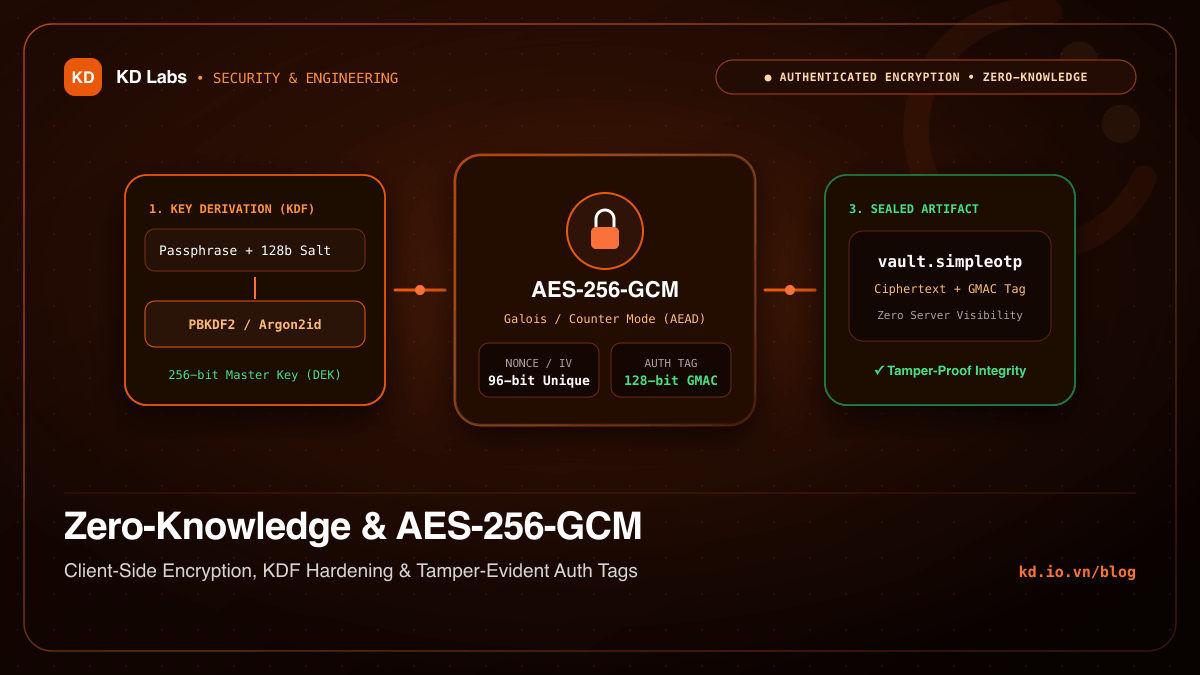
Nearly every cloud service today reassures users that their data is “encrypted at rest in the cloud.” Yet year after year, hundreds of millions of personal records, private documents, and credential vaults are leaked from major cloud infrastructures.
This paradox stems from a widespread confusion between Server-Side Encryption (SSE) and Zero-Knowledge Architecture (Client-Side Authenticated Encryption). In this engineering breakdown, KD Labs explores the design principles of true Zero-Knowledge storage and dissects AES-256-GCM—the gold standard of modern symmetric cryptography.
1. The “Encrypted in the Cloud” Illusion vs. Zero-Knowledge Architecture
When you upload a backup file to a conventional cloud service, protection typically stops at Encryption-in-Transit (TLS/HTTPS) and Server-Side Encryption-at-Rest:
- Your data travels over an encrypted TLS tunnel to the vendor’s cloud server.
- Inside the server’s memory, your payload is terminated into plaintext, processed, and re-encrypted using keys managed by the cloud provider before being written to disk.
What happens if that provider suffers a supply-chain breach, a database misconfiguration, or an insider compromise? Because the cloud server holds both the ciphertext and the decryption keys, an attacker who breaches the server perimeter gains access to your plaintext data.
By contrast, in a Zero-Knowledge Architecture:
- Key derivation and encryption execute 100% locally on your device before a single byte ever touches a filesystem export or external medium.
- Your Master Passphrase never leaves volatile device memory.
- Even if you store the resulting encrypted archive on a public cloud drive, send it over email, or copy it to a USB flash drive that gets lost, anyone who intercepts the file sees only computationally indistinguishable random noise (Ciphertext).
“In a true Zero-Knowledge system, you never have to hope a server stays unbreached—because even if an adversary captures the entire storage medium, they capture only unbreakable math.”
2. From Human Passphrases to 256-bit Keys: KDF Hardening & Cryptographic Salts
The AES-256 cipher requires an exact 256-bit (32-byte) key with uniform cryptographic entropy. Humans, however, cannot memorize 32 random bytes; we rely on human-memorable passphrases.
If an application naively hashes your passphrase with a single fast pass of SHA-256 to produce an AES key, an attacker equipped with a modern multi-GPU rig can test over 20 billion candidate passwords per second offline.
To transform a human passphrase into a brute-force-resistant cryptographic key, the system must pass the secret through a Key Derivation Function (KDF) such as PBKDF2-HMAC-SHA256 or Argon2id:
[ User Passphrase ]  +  [ 128-bit Random Cryptographic Salt ]
                                     │
                                     ▼
                    ┌─────────────────────────────────┐
                    │   PBKDF2-HMAC-SHA256 / Argon2   │
                    │  100,000+ Computational Rounds  │
                    └─────────────────────────────────┘
                                     │
                                     ▼
                   [ 256-bit Derived Vault Key (DEK) ]
Why Both a 128-bit Salt and 100,000+ Iterations Matter
- Defeating Precomputed Rainbow Tables: Every time a backup is exported, the app generates a fresh 16-byte (128-bit) Salt from the operating system’s hardware random number generator (
CSPRNG). Because the salt is unique per file, encrypting the exact same vault twice with the same password yields completely different keys and ciphertexts. - Intentional Computational Friction (Key Stretching): Executing 100,000 iterations of PBKDF2-HMAC-SHA256 takes roughly 50–80 milliseconds on a modern smartphone—imperceptible during a single legitimate unlock. For an attacker attempting 1 billion guesses, however, the computational workload multiplies by 100,000x, turning a minutes-long crack into decades.
3. Why AES-256-GCM? The Power of Authenticated Encryption (AEAD)
Legacy encryption tools frequently rely on AES-256-CBC (Cipher Block Chaining). While AES-CBC hides plaintext patterns, it suffers from a critical cryptographic flaw: it provides zero built-in integrity verification (Malleability).
If an attacker intercepts an AES-CBC encrypted backup file and flips specific bits in the ciphertext—or exploits a Padding Oracle side channel—the decrypting parser can be tricked into processing corrupted payloads or leaking plaintext bytes.
This is why AES-256-GCM (Galois/Counter Mode – NIST SP 800-38D) became the mandatory cipher suite for TLS 1.3 and modern cryptographic vaults. AES-256-GCM is an AEAD (Authenticated Encryption with Associated Data) primitive that guarantees both confidentiality and tamper-evident authenticity in a single pass:
The Dual Engine Inside AES-256-GCM:
- Confidentiality Engine (Counter Mode – CTR): Turns the AES-256 block cipher into a high-speed stream cipher by combining a unique 96-bit (12-byte) Nonce / IV with an incrementing block counter, XORing the resulting keystream with your plaintext to produce
Ciphertext. - Integrity Engine (Galois Field Multiplication – GMAC): In parallel, every ciphertext block is multiplied across the binary Galois Field $GF(2^{128})$ to compute a 128-bit (16-byte) Authentication Tag (GMAC) appended to the end of the payload.
During decryption, before a single byte of plaintext is released to the application, the AES-GCM engine recomputes the GMAC tag over the ciphertext and verifies it in constant time. If even a single bit of the backup file was modified—whether by storage corruption or deliberate tampering—decryption immediately aborts with an authentication error.
4. Anatomy of a Zero-Knowledge Backup Container (.simpleotp)
To see how a self-contained, server-independent encrypted backup works in practice, here is a clean TypeScript reference implementation using the standard Web Crypto API:
/**
 * Seals a JSON payload inside a Zero-Knowledge container: PBKDF2 (100k rounds) + AES-256-GCM
 */
export async function encryptZeroKnowledgeBackup(
  plaintextJson: string,
  passphrase: string
): Promise<Uint8Array> {
  const encoder = new TextEncoder();

  // 1. Generate 16-byte random Salt and 12-byte unique Nonce (IV) via hardware CSPRNG
  const salt = crypto.getRandomValues(new Uint8Array(16));
  const iv = crypto.getRandomValues(new Uint8Array(12));

  // 2. Stretch passphrase into a 256-bit key across 100,000 PBKDF2-SHA256 iterations
  const baseKey = await crypto.subtle.importKey(
    'raw',
    encoder.encode(passphrase),
    'PBKDF2',
    false,
    ['deriveKey']
  );

  const aesGcmKey = await crypto.subtle.deriveKey(
    {
      name: 'PBKDF2',
      salt,
      iterations: 100_000,
      hash: 'SHA-256',
    },
    baseKey,
    { name: 'AES-GCM', length: 256 },
    false,
    ['encrypt', 'decrypt']
  );

  // 3. Encrypt with AES-256-GCM (Automatically appends 128-bit GMAC Auth Tag)
  const ciphertextWithTag = new Uint8Array(
    await crypto.subtle.encrypt(
      { name: 'AES-GCM', iv, tagLength: 128 },
      aesGcmKey,
      encoder.encode(plaintextJson)
    )
  );

  // 4. Pack binary envelope: [Salt (16B)] + [IV (12B)] + [Ciphertext + AuthTag]
  const sealedContainer = new Uint8Array(
    salt.length + iv.length + ciphertextWithTag.length
  );
  sealedContainer.set(salt, 0);
  sealedContainer.set(iv, salt.length);
  sealedContainer.set(ciphertextWithTag, salt.length + iv.length);

  return sealedContainer;
}
Critical Engineering Invariant: Never reuse the same
(Key, Nonce/IV)pair across two AES-GCM encryptions. By generating both a fresh 128-bitSalt(producing a brand-new derived key) and a fresh 96-bitIVon every backup export, Nonce collision risk is mathematically eliminated.
5. Comparing Symmetric Block Cipher Modes
| Cryptographic Property | AES-ECB (Legacy) | AES-CBC (Traditional) | AES-256-GCM (Modern AEAD) |
|---|---|---|---|
| Pattern Concealment | ❌ Poor (Leaks block repetition) | ✅ Strong (Randomized via IV) | ✅ Complete (Unique keystream) |
| Tamper Detection (Integrity) | ❌ None | ❌ None (Requires separate HMAC) | ✅ Built-in 128-bit GMAC Auth Tag |
| Padding Oracle Immunity | ❌ Vulnerable | ⚠️ High risk if errors leak | ✅ Immune (Stream mode, no padding) |
| Hardware Parallelization | ✅ Parallel | ❌ Sequential encryption | ✅ Fully parallelizable with AES-NI / ARMv8 Crypto |
6. How KD Labs Implements Data Sovereignty in Simple OTP
At KD Labs, we believe personal data sovereignty should never depend on trusting a remote server. That principle shapes every layer of Simple OTP:
- Zero Cloud Sync Servers: We operate no user databases, no cloud sync endpoints, and no telemetry collectors.
- Zero-Knowledge
.simpleotpEncrypted Backups: When you export your vault to migrate phones or create a disaster-recovery copy, Simple OTP derives a 256-bit key from your personal passphrase using 100,000 iterations of PBKDF2 and seals the payload with AES-256-GCM locally on your device. - Store Anywhere with Confidence: Because every
.simpleotpfile is cryptographically authenticated and encrypted before it leaves the app, you can safely store backups on a USB drive, SD card, NAS, or cloud folder knowing no third party can inspect or tamper with your keys.
Final Thoughts
Encryption is more than a compliance checkbox—it is the mathematical boundary that preserves personal sovereignty in an era of centralized data breaches. Whether you are choosing a password manager, an encrypted notes tool, or a 2FA authenticator, insist on client-side Zero-Knowledge architecture backed by authenticated AES-256-GCM cryptography.