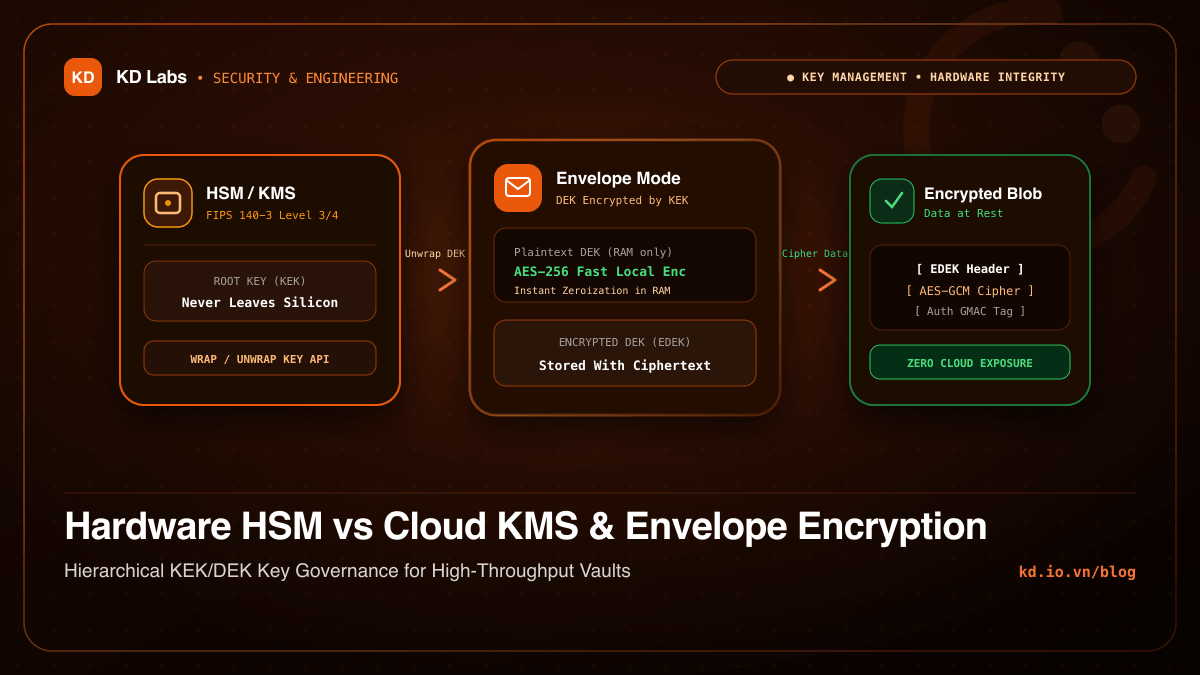
Across the security architectures of global banking institutions, fintech platforms, and enterprise clouds, one cryptographic conundrum dominates systems engineering: How do we encrypt petabytes of sensitive records at microsecond latencies while guaranteeing that the root cryptographic key can never be exfiltrated or copied?
Pumping gigabytes of streaming data across the network into a dedicated cryptographic hardware module creates an immediate bandwidth choke point. Conversely, persisting raw symmetric keys directly within application memory to achieve line-rate throughput invites catastrophe: a single heap-inspection flaw or debug crash dump leaks the master key to an attacker.
The elegant resolution to this paradox is the marriage between Hardware Security Modules (HSM) / Cloud KMS and the architectural pattern known as Envelope Encryption.
1. Dedicated Hardware HSMs: The FIPS 140-3 Silicon Fortress
A Hardware Security Module (HSM) is a hardened, physical computing appliance engineered for a single purpose: to generate, store, and execute cryptographic primitives within an unbreachable physical security perimeter.
┌────────────────────────────────────────────────────────────────────────┐
│                   PHYSICAL HARDWARE SECURITY MODULE                    │
│                                                                        │
│   • Tamper-evident & resin-potted chassis enclosures                   │
│   • Voltage, temperature & high-energy laser intrusion sensors         │
│   • Sub-nanosecond Active Zeroization Circuitry                        │
│   • Hardware Quantum/Thermal Random Number Generators (TRNG)           │
│                                                                        │
│         CRYPTOGRAPHIC KEYS NEVER CROSS THE SILICON BOUNDARY!           │
└────────────────────────────────────────────────────────────────────────┘
The FIPS 140-3 Security Benchmarks:
- Level 1: Validates algorithmic correctness within software execution environments.
- Level 2: Mandates physical tamper-evident seals and lockable enclosures.
- Level 3: Requires active environmental tamper-detection circuitry. If an intruder attempts micro-drilling, decapping, or voltage glitching, the module triggers capacitor discharge to erase all volatile key memory registers within nanoseconds (Zeroization).
- Level 4: Extends active defense against extreme external environmental anomalies, including cryogenic freezing and electromagnetic radiation injection.
2. The Cloud KMS Evolution (AWS KMS, Google Cloud KMS, Azure Key Vault)
While on-premise physical HSMs deliver unyielding physical assurance, their deployment demands steep capital expenditure (often hundreds of thousands of dollars per redundant cluster) and specialized cryptographic operational staff.
Cloud service providers abstracted these appliances into Cloud Key Management Services (Cloud KMS):
- Multi-Tenant FIPS 140-2/3 Level 3 Hardware Fleets: Virtual key objects reside in dedicated vendor-managed HSM clusters.
- Dedicated Cloud HSM (Single-Tenant): Enterprises provision isolated physical hardware partitions inside cloud availability zones to satisfy PCI-DSS or FedRAMP High compliance.
- Immutable Auditing: Every cryptographic operation (wrapping, unwrapping, signing) is recorded in tamper-evident logs (e.g., AWS CloudTrail), creating an unbroken chain of custody.
3. The Envelope Encryption Architectural Pattern
Imagine encrypting a 10 GB database backup or millions of biometric identity images:
- Transmitting that 10 GB over the wire to a Cloud KMS API creates massive network overhead, skyrockets API invocation costs, and introduces intolerable latency.
- Envelope Encryption mitigates these constraints through a two-tiered key hierarchy:
TIER 1: KEY ENCRYPTION KEY (KEK / Master Key)
• Resides perpetually inside the HSM / Cloud KMS silicon boundary
• Non-exportable under any authorization level
• Used solely to wrap and unwrap lightweight data keys
                      │
                      ▼ (Wrap operation)
TIER 2: DATA ENCRYPTION KEY (DEK)
• High-performance 256-bit symmetric AES key
• Generated uniquely per document, partition, or database row
• Executes line-rate encryption directly on the application host
3.1. The Encryption Lifecycle
- The application invokes
GenerateDataKey(KEK_ID)against the Cloud KMS endpoint. - The KMS generates a 256-bit AES key inside its HSM, returning two representations:
- Plaintext DEK: Ephemeral raw key material retained strictly in volatile RAM.
- Encrypted DEK (EDEK): The DEK wrapped by the HSM’s root KEK.
- The application encrypts the 10 GB payload locally using the Plaintext DEK under AES-256-GCM at line speed.
- Immediately upon completion, the application explicitly zeroizes the Plaintext DEK from RAM.
- The ciphertext is persisted alongside the Encrypted DEK (EDEK) stored directly within the metadata header.
┌────────────────────────────────────────────────────────────┐
│                  ENVELOPE-SEALED DATA BLOB                 │
│                                                            │
│  [ Header: Encrypted Data Key (EDEK) ] ◄── Unforgeable     │
│  [ Payload: 10 GB AES-256-GCM Ciphertext ]                 │
│  [ Footer: 128-bit GMAC Authentication Tag ]               │
└────────────────────────────────────────────────────────────┘
Even if an adversary compromises the storage volume containing this payload, they acquire only ciphertext and an opaque EDEK blob. Without the IAM permissions required to unwrap the EDEK inside the KMS, the data remains mathematically unrecoverable.
3.2. The Decryption Lifecycle
- The application extracts the
EDEKfrom the file header and dispatches anUnwrap(KEK_ID, EDEK)call to Cloud KMS. - The HSM unwraps the DEK using its internal KEK and transmits the
Plaintext DEKover a mutually authenticated TLS connection. - The application decrypts the payload, validates the GMAC authentication tag, and instantly wipes the DEK from memory.
4. Architecture Matrix: On-Premises HSM vs Cloud KMS
| Metric | On-Premise Physical HSM | Cloud KMS / Cloud HSM |
|---|---|---|
| Capital Expenditure | Substantial upfront hardware cost | Elastic pay-as-you-go billing |
| Maintenance Overhead | Dedicated physical security personnel | Fully managed by cloud provider |
| API Call Latency | Sub-millisecond across local LAN | Milliseconds over internet / direct interconnects |
| Scalability | Bound by physical chassis throughput | Scales horizontally to tens of thousands ops/sec |
| Sovereignty | Complete physical custody | Shared trust model with cloud vendor |
5. Architectural Alignment at KD Labs
The hierarchical principles of Envelope Encryption mirror the client-side architecture powering KD Labs’ flagship security app, Simple OTP:
- Hardware-Anchored KEK: Root keys are bound irrevocably to the mobile device’s Apple Secure Enclave or Android StrongBox Keystore, never traversing off-device.
- Local High-Throughput DEK: Vault databases are encrypted with ephemeral AES-256-GCM keys, delivering zero-latency token lookups.
- Decentralized Cryptographic Autonomy: Rather than delegating trust to remote cloud KMS nodes, Simple OTP turns your personal smartphone into a sovereign, air-gapped Hardware Security Module.
By uniting physical silicon tamper-resistance with the speed of local symmetric ciphers, Envelope Encryption proves that world-class cryptographic defense and frictionless user experience can exist in perfect harmony.