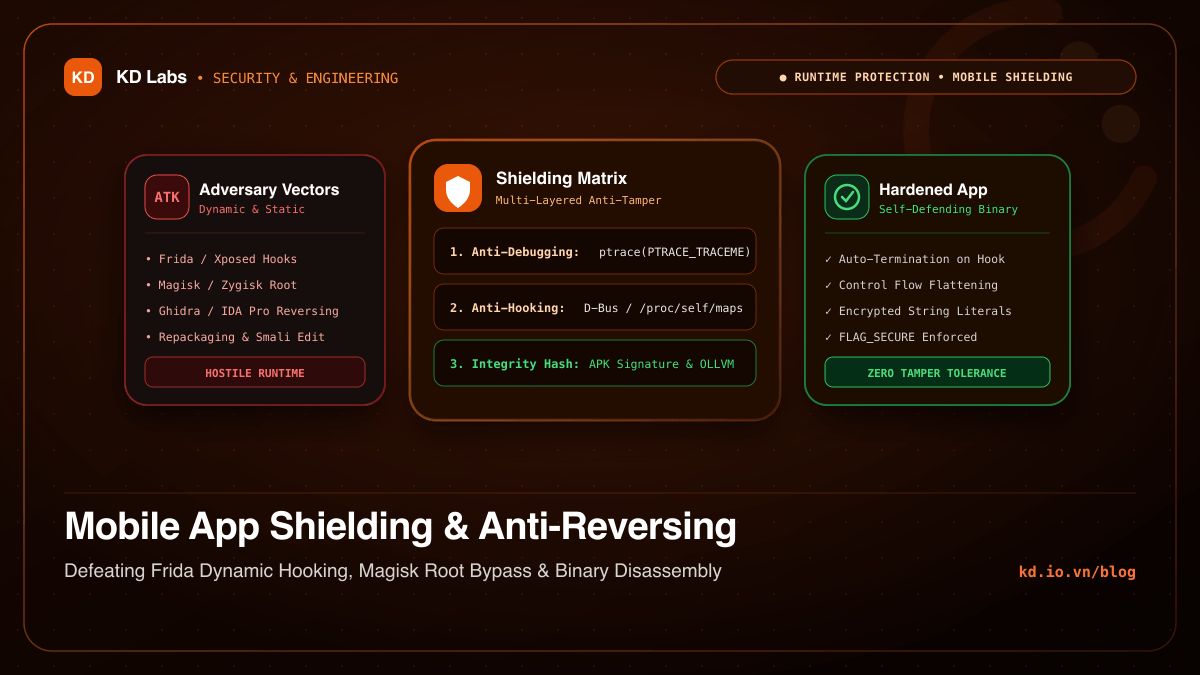
When distributing a mobile application via the Google Play Store or Apple App Store, software teams execute an inherently perilous action: placing compiled executable binaries (APK, AAB, or IPA) directly into the hands of untrusted operators — including security researchers, black-hat syndicates, and automated exploit scanners.
Unlike backend server systems—where application logic executes securely behind firewalls and hardened perimeter proxies—the client mobile device is a fundamentally hostile environment:
- End-users can compromise system sandboxing (Root via Magisk/KernelSU on Android, or Jailbreak via Dopamine on iOS).
- Attackers can attach interactive debuggers, inject dynamic instrumentation hooks (Frida), alter compiled instruction branches (Binary Patching with Ghidra), or inspect sensitive in-memory cryptographic state.
To safeguard high-risk applications—such as banking suites, decentralized wallets, and sovereign authenticators like Simple OTP—engineers must implement robust Application Shielding and Anti-Tampering Defenses.
1. The Mobile Adversary Attack Matrix
┌────────────────────────────────────────────────────────────────────────┐
│                   MOBILE REVERSE ENGINEERING VECTORS                   │
├──────────────────────────────────┬─────────────────────────────────────┤
│ 1. STATIC DISASSEMBLY            │ • Decompile bytecode with Jadx      │
│                                  │ • Smali instruction injection       │
│                                  │ • Native decompilation with Ghidra  │
├──────────────────────────────────┼─────────────────────────────────────┤
│ 2. DYNAMIC INSTRUMENTATION       │ • In-memory API hooks via Frida     │
│                                  │ • Biometric / PIN bypass injections │
│                                  │ • Debugger attachment (GDB/LLDB)    │
├──────────────────────────────────┼─────────────────────────────────────┤
│ 3. RUNTIME ENVIRONMENT TAMPERING │ • Root hiding via Zygisk modules    │
│                                  │ • Virtual container execution       │
│                                  │ • Malicious Accessibility scrapers  │
└──────────────────────────────────┴─────────────────────────────────────┘
2. Thwarting Frida and Dynamic Runtime Instrumentation
Frida represents the premier dynamic instrumentation framework in modern vulnerability research. By injecting a native shared object (.so / .dylib) directly into the target process memory space, Frida enables an attacker to author concise JavaScript hooks to:
- Intercept and log sensitive arguments passed into cryptographic functions.
- Force biometric authentication checks or entitlement gates to return boolean
true. - Siphon raw decrypted private keys directly out of volatile heap allocations.
2.1. Inspecting Memory Maps for Rogue Modules
Frida agents leave observable signatures within the process virtual memory mapping (/proc/self/maps on Linux/Android):
#include <stdio.h>
#include <string.h>
#include <stdbool.h>

bool detect_injected_frida_agent() {
    FILE *maps_file = fopen("/proc/self/maps", "r");
    if (!maps_file) return false;

    char buffer[512];
    bool detected = false;
    while (fgets(buffer, sizeof(buffer), maps_file)) {
        if (strstr(buffer, "frida-agent") ||
            strstr(buffer, "frida-gadget") ||
            strstr(buffer, "gum-js")) {
            detected = true;
            break;
        }
    }
    fclose(maps_file);
    return detected;
}
2.2. Defensive Self-Tracing via ptrace
Under Linux and Android kernel process scheduling, a process can be traced by at most one supervisor thread:
#include <sys/ptrace.h>
#include <unistd.h>
#include <stdlib.h>

void enforce_anti_debug_boundary() {
    // Attempt to trace ourselves with PTRACE_TRACEME
    if (ptrace(PTRACE_TRACEME, 0, 1, 0) < 0) {
        // Another tracer (LLDB, GDB, or Frida) is already attached!
        // Immediately terminate execution without surfacing error diagnostics
        _exit(1);
    }
}
3. Detecting Advanced Root Mechanisms (Magisk & Zygisk)
Modern Android privilege escalation frameworks like Magisk and KernelSU operate through Zygisk, hooking directly into the zygote parent process before application sandboxes are initialized. This architecture enables attackers to intercept libc wrappers, hide /system/bin/su binaries, and falsify system properties (ro.build.tags, ro.debuggable).
To detect deep system compromise, applications must deploy independent defense heuristics:
- Direct Mount Table Auditing: Parse
/proc/self/mountinfodirectly to uncoveroverlayfsmounts and synthetictmpfsoverlays frequently utilized by Magisk modules to mask system modifications. - Direct Kernel Syscalls: Execute low-level raw Linux syscalls (
svc #0on ARM64) to probe sensitive filesystem paths, circumventing libc-level hooks installed by dynamic instrumentation hooks. - Hardware-Attested Integrity (Google Play Integrity & Apple DeviceCheck): Delegate boot integrity verification (verifying an unlocked bootloader or compromised kernel image) to hardware tokens verified through cloud attestation certificates signed by the hardware manufacturer.
4. Compiler-Level Obfuscation (Obfuscator-LLVM)
When an adversary inspects raw compiled binaries in Ghidra or IDA Pro, standard symbol layouts and clean control flow graphs provide an open roadmap for vulnerability exploitation. Sensitive native modules must be processed through Obfuscator-LLVM (OLLVM) pipelines:
ORIGINAL LOGIC                               FLATTENED CONTROL FLOW
if (validate_vault_access()) {               uint32_t state = 0x8F3A2109;
    decrypt_master_seed();                   while (state != 0x0) {
} else {                                         switch(state ^ runtime_seed) {
    purge_cached_state();                            case 0x12: ...; state = 0x4B; break;
}                                                    case 0x4B: ...; state = 0x99; break;
                                                     ... (hundreds of synthetic basic blocks)
Essential Obfuscation Primitives:
- Control Flow Flattening: Dissolves standard conditional branches and loops into complex, flat
while-switchdispatchers governed by dynamically calculated state variables, rendering static graph analysis intractable. - Constant & String Literal Encryption: String primitives (server endpoints, configuration keys, cryptographic salts) are stored exclusively as encrypted byte buffers, decrypted transiently onto the stack at execution time and zeroized immediately thereafter.
- Instruction Substitution: Basic arithmetic instructions are replaced with computationally equivalent complex boolean polynomial identities, defeating automated decompiler pattern matching.
5. Screen Scraping Defense: Enforcing FLAG_SECURE
An often underappreciated vector is screen exfiltration via rogue background services abusing Android’s Accessibility APIs:
// Android Activity Configuration:
override fun onCreate(savedInstanceState: Bundle?) {
    super.onCreate(savedInstanceState)

    // Defends against screenshots, screen recorders, and preview caching
    window.setFlags(
        WindowManager.LayoutParams.FLAG_SECURE,
        WindowManager.LayoutParams.FLAG_SECURE
    )
}
In Simple OTP, FLAG_SECURE is an uncompromised default setting, ensuring that transient TOTP tokens and QR scanning sessions remain invisible to host screen scrapers.
6. The KD Labs Defense-in-Depth Paradigm
No standalone software obfuscation or anti-tamper check is impregnable. Given sufficient financial motivation and computational time, a dedicated reverse engineer can eventually map and disassemble client binaries.
Consequently, security at KD Labs is structured around Layered Defense-in-Depth:
- Tier 1 - Runtime Application Self-Protection (RASP): Active ptrace validation, Frida detection, and root heuristics trigger silent process termination upon detected tampering.
- Tier 2 - Silicon-Anchored Keys: Even if client application logic is completely decompiled, raw private keys remain sealed inside Apple Secure Enclave or Android StrongBox Keystore chips, physically inaccessible to the host OS.
- Tier 3 - Zero-Knowledge Architecture: The application makes zero remote network calls, eradicating man-in-the-middle, replay, and telemetry exfiltration vectors entirely.
Securing client-side mobile applications requires acknowledging that the user device is inherently untrusted. By combining compiler-level hardening, proactive runtime anti-tampering heuristics, and physical hardware roots of trust, we ensure that user credentials remain mathematically fortified against hostile execution environments.